
Keep the interface responsive to the task
Model interaction and feedback around loading, failure and completion rather than only the successful click.
Check slow responses and repeated actions.
JavaScript application work across browser interfaces and Node.js services, with clear environment boundaries, validation and maintainable modules.
Plan your JavaScript projectModel interaction and feedback around loading, failure and completion rather than only the successful click.
Browser code and server code have different access and operating responsibilities.
Explicit modules, contracts and automated checks help a team understand what a change affects.
Connect accessible controls to state transitions and the actual server contract.
Test keyboard actions, incomplete records and errors.
Validate the request and response at the point each enters the application.
Inspect authorization, retries and unexpected data.
Use TypeScript where it clarifies recurring records and module boundaries.
Keep runtime validation for unknown inputs.
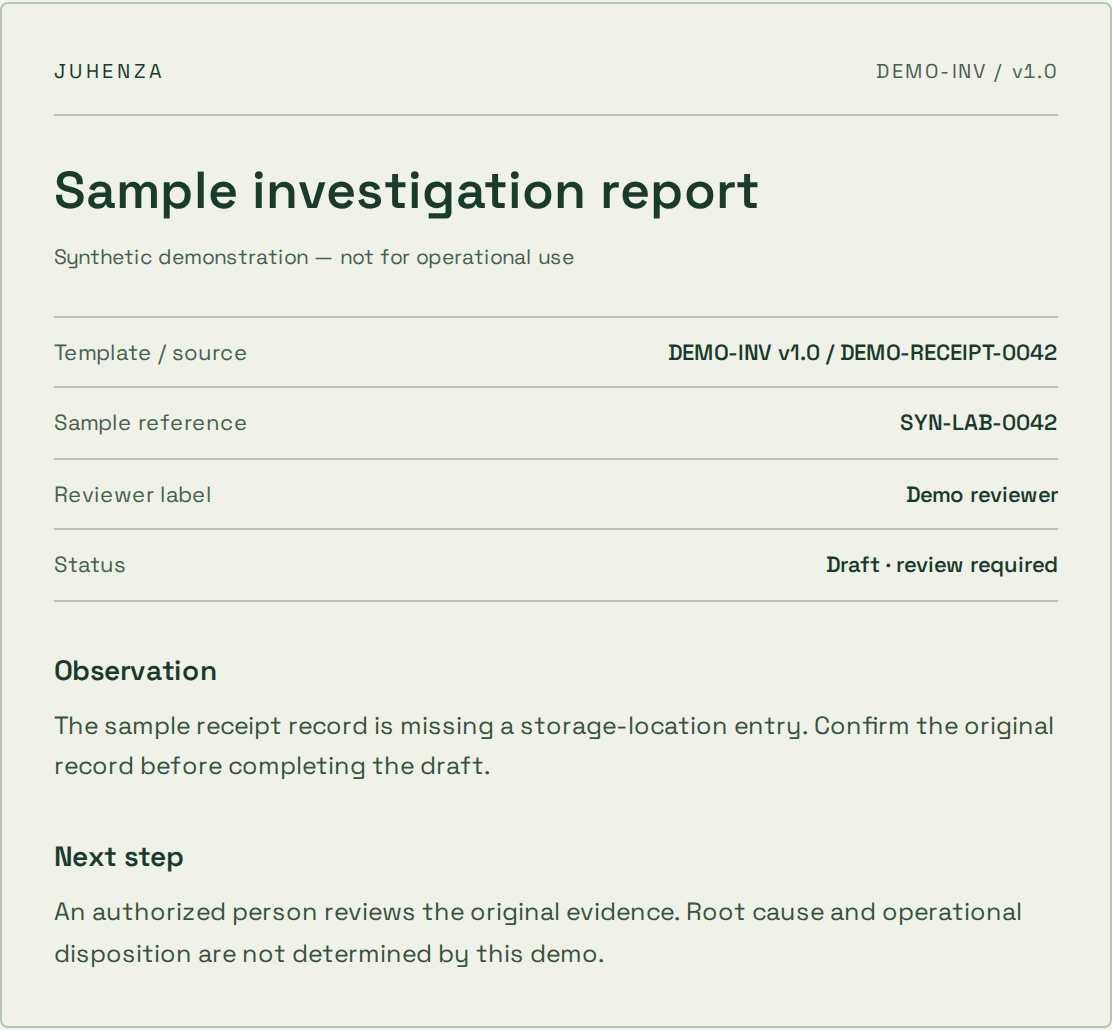
Edit an observation. Inspect the generated draft. Confirm your sample review before exporting a PDF.
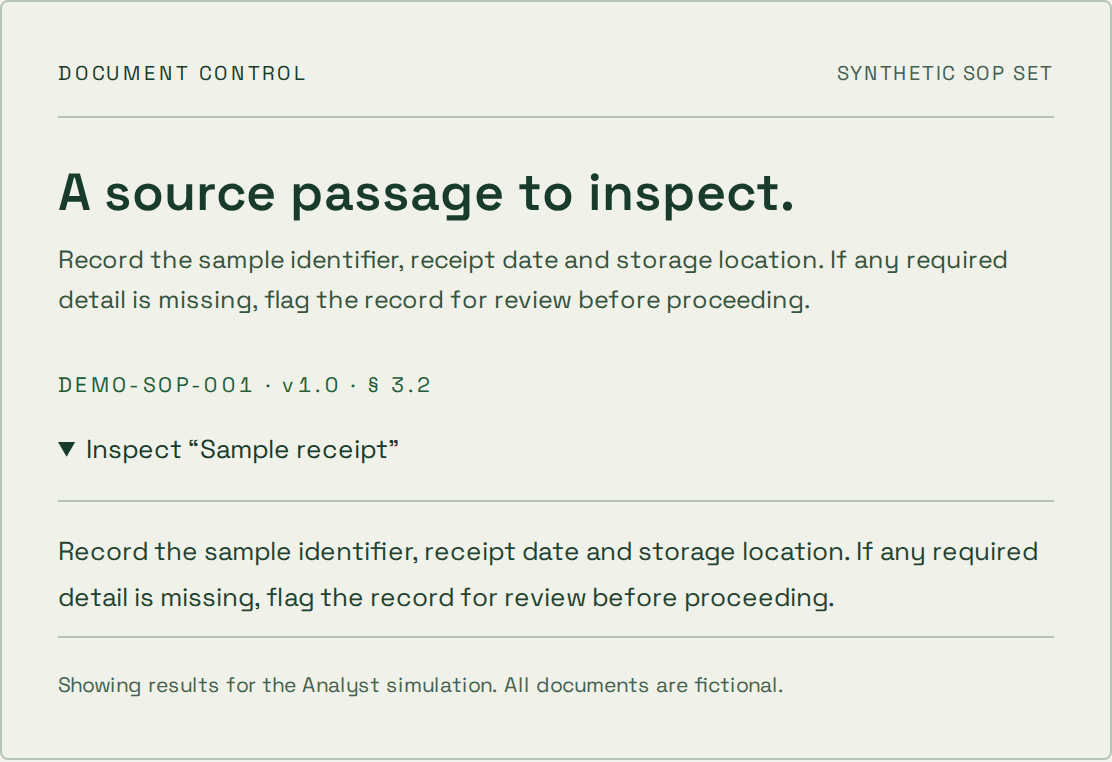
Explore a synthetic SOP library and inspect the source passage. Try a restricted role or an unsupported question.
The problem is clear, but the approach is not.
A bounded experiment, findings and a recommendation on what to validate next.
A prototype is not a production-ready service.
You know the workflow and can agree acceptance checks.
Agreed deliverables, verification evidence and operating instructions for the scoped release.
Changes to scope need an explicit decision on cost and timing.
A live system needs focused changes or ongoing care.
A prioritized backlog, reviewed changes and an agreed maintenance or support boundary.
Coverage, response targets and access are agreed per engagement.
Structure interaction and state around the complete user task. Keep server credentials and private configuration out of browser bundles.
Define APIs and background work with validation, permissions and traceable failure handling. Use runtime checks for external inputs.
Review dependency boundaries, build behavior and regression risk. Use TypeScript where stronger contracts help the team maintain the application.
Practical answers before the build. Bring the details of your project to the conversation.
Yes. Start with the affected workflows, module boundaries, build system and dependencies.
No. Review whether incremental adoption would clarify the highest-risk contracts first.
Use the task, permissions and data sensitivity to establish the boundary. An interactive interface does not need direct access to privileged operations.
Bring the problem you want solved. We’ll shape it into a project brief you can keep — or let AI draft a first approach.